Locksmith Vs Safe Technician Difference
The primary difference between a locksmith and a safe technician lies in the specific hardware and security levels they handle. A locksmith focuses on the security of buildings and vehicles, working with door locks, ignition cylinders, and electronic entry systems. A safe technician specializes exclusively in high-security storage containers, including home safes, commercial vaults, and bank equipment. While many locksmiths offer basic safe services like battery changes, safe technicians possess the specialized knowledge and heavy machinery required to open failed locks or repair units after a burglary attempt.
Understanding these distinctions ensures that property owners hire the right expert for their specific security problem. A locksmith is the go-to professional for house lockouts or rekeying a business. A safe technician is necessary when a dial fails to turn, a digital keypad malfunctions, or a vault requires a certified inspection. Professional security work requires precision, and selecting the wrong specialist can lead to unnecessary damage to expensive hardware. This guide provides a detailed look at the skills, tools, and industry standards that separate these two fields.
Primary Roles and Responsibilities
Locksmiths operate as generalists in the physical security industry. Their daily tasks involve installing deadbolts, repairing door closers, and programming automotive keys. They understand the mechanics of pin tumbler locks and lever locks found in residential and commercial settings. Much of their work involves the movement of people through entryways, ensuring that locks function smoothly while maintaining fire code compliance.
Safe technicians operate in a more narrow but technically demanding environment. Their work centers on the containment of assets rather than the security of a building perimeter. They manage complex locking mechanisms like mechanical rotary dials, time locks, and biometric safe controllers. Because safes are designed to resist forced entry, a safe technician must understand the internal engineering of steel barriers and relocking devices. If a safe lock breaks, the technician uses diagnostic skills to determine if the failure is mechanical or electronic before attempting a repair.
Specialized Tooling and Equipment
The tools found in a locksmith’s van differ greatly from those in a safe technician’s workshop. Locksmiths rely on picks, tension wrenches, and key cutters. They use plug followers and tweezers to manipulate small springs and pins during a rekeying process. Their equipment is generally portable and designed for quick adjustments to standard door hardware.
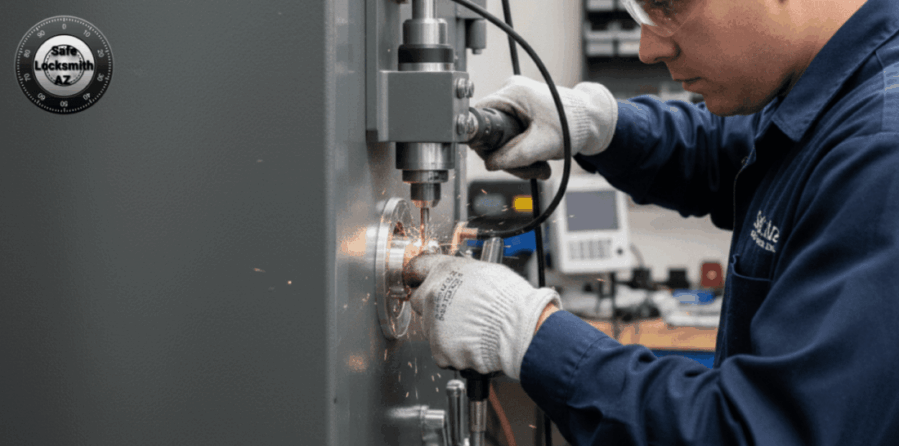
Safe technicians use heavy-duty industrial equipment. This includes magnetic drill presses that attach directly to the safe door and high-speed carbide or diamond-tipped drill bits. They also use borescopes to look inside a safe door through a tiny hole to observe the movement of the locking wheels. While a locksmith might use a shim to bypass a door latch, a safe technician uses mathematical manipulation to find a lost combination or specialized pullers to remove a stuck dial.
Service Comparison
| Feature | Locksmith | Safe Technician |
|---|---|---|
| Primary Hardware | Door locks, car ignitions, gates | Burglary safes, fire safes, vaults |
| Opening Methods | Picking, bumping, bypass tools | Manipulation, drilling, scoping |
| Security Focus | Access control and perimeter safety | Asset protection and container integrity |
| Key Knowledge | Master key systems and automotive | Combination dials and time locks |
| Technical Complexity | Moderate mechanical variety | High mechanical and structural depth |
Training and Certification Requirements
Education for these two paths often starts in the same place but branches out as a professional gains experience. Many technicians begin with a general locksmithing apprenticeship. To become a safe technician, an individual typically pursues advanced training through organizations like the Safe and Vault Technicians Association. This specialized training covers safe construction standards, drill point locations, and the repair of UL-rated containers.
Professional certifications provide a way for consumers to verify expertise. A Certified Registered Locksmith (CRL) has proven knowledge in general lock repair. However, a Certified Professional Safe Technician (CPST) has passed rigorous exams specifically on safe locks and vault doors. These credentials indicate that the technician follows industry-standard protocols and possesses a high level of technical proficiency.
Bonus Tip: Always check if a safe technician is a member of a professional organization like SAVTA. Membership often grants them access to a private database of safe blueprints and drill points that general locksmiths cannot access.
Market Data and Industry Trends
The demand for security professionals continues to grow as property owners look for better ways to protect their assets. Data from the U.S. Bureau of Labor Statistics shows that employment for locksmiths and safe repairers remains stable, with thousands of job openings projected each year. While the roles overlap in government data, the private sector has seen an increase in the need for safe technicians due to the rising sales of home safes and firearm storage units.
Security trends are also shifting toward electronic integration. Electronic safe market growth trends show increasing adoption of digital and smart safes, driving demand for technicians skilled in circuit boards and electronic locking systems. This shift means modern safe technicians must move beyond traditional mechanical dials. Locksmiths are seeing a similar transition toward smart locks and mobile-controlled entry systems for homes.
Factors to Consider Before Hiring
Choosing between these two professionals depends on the specific hardware in question. If a homeowner is locked out of their house, a locksmith is the most efficient choice. If a business cannot open a heavy-duty vault containing cash or sensitive documents, a safe technician is required. Safe Locksmith AZ recommends checking several factors before making a decision.
First, identify the brand and model of the lock or safe. Some specialized European safes require specific tools that only a dedicated safe technician owns. Second, consider the value of the items inside. If a safe contains high-value assets, hiring a certified technician ensures the unit is opened with minimal damage and can be returned to its original security rating. Third, ask about the method of entry. A general locksmith might suggest “grinding” a safe open, which ruins the container. A professional safe technician will aim to drill a single small hole that can be repaired, preserving the safe’s integrity.
Bonus Tip: If a digital safe keypad stops responding, try replacing the battery with a fresh name-brand 9V battery before calling a technician. This simple fix solves nearly half of all safe lockout calls.
Common Questions
Professional technicians often encounter the same inquiries from clients who are unsure which service they need.
Can a locksmith open any safe?
Most locksmiths can open small, inexpensive “Sentry” style safes found in big-box stores. These usually involve simple bypass techniques. However, for high-security safes with UL ratings, a general locksmith may lack the blueprints and heavy drilling equipment required for a successful opening.
Is a safe technician more expensive than a locksmith?
Generally, yes. Safe technicians invest thousands of dollars in specialized drills, scopes, and diagnostic software. Their work is often more time-consuming and carries a higher risk. While a house lockout might take fifteen minutes, opening a failed vault can take several hours of precision labor.
Does drilling a safe ruin it?
When a professional safe technician drills a safe, they do so tactically. They drill a small hole to bypass a specific part of the lock. After the safe is open, the hole is filled with a hardplate taper pin and welded or sealed. This process maintains the fire and burglary rating of the safe, allowing it to remain in use.
Additional Knowledge for Property Owners
Safe Manipulation vs. Forced Entry
One of the most impressive skills of a safe technician is manipulation. This involves listening to the mechanical sounds of the dial and feeling the “contact points” to determine the combination. This method leaves no damage. Locksmiths rarely practice this skill as it takes years to master. If a technician immediately reaches for a saw or a torch, they are likely not a trained safe specialist.
The Role of UL Ratings
Underwriters Laboratories (UL) tests safes for their resistance to fire and tools. A safe technician understands these ratings (such as RSC, TL-15, or TL-30) and knows exactly how much force or heat a safe can withstand. This knowledge is vital for insurance compliance. Hiring a non-specialist to repair a UL-rated safe could void an insurance policy if the repair is not done to factory standards.
Frequently Asked Questions
The following answers address further specific concerns property owners often have regarding their security hardware.
What should I do if my safe combination stops working?
Stop trying the combination after three failed attempts. Many digital safes have a lockout penalty that increases with every wrong entry. Check the handle for any tension and ensure the door is pushed completely shut. If the dial feels loose or “gritty,” call a safe technician immediately to avoid a total mechanical failure.
Do I need a locksmith for a commercial keypad?
If the keypad is on a standard office door, a locksmith is the right choice. They specialize in access control systems that manage building entry. If the keypad is on a safe or a vault, a safe technician should handle it to ensure the internal relockers are not accidentally triggered.
Can a locksmith change the combination on my safe?
A locksmith who has basic safe training can often change a combination if the safe is already open. However, if the lock is old or a high-security mechanical dial, a safe technician is better equipped to service the internal wheels and ensure the new combination is set accurately without “ghosting” numbers.
How do I find the model number of my safe?
The model number is usually located on a small metal plate on the front or side of the door. Sometimes it is found on the interior of the door jamb. Providing this information to a safe technician helps them bring the correct tools and replacement parts for the job.
Summary of Key Differences
Distinguishing between a locksmith and a safe technician is about matching the expert to the mechanism. Locksmiths are essential for maintaining the security and accessibility of buildings and vehicles. They handle the high volume of daily lock and key issues that keep society moving. Safe technicians are specialists who protect the most sensitive assets by maintaining the integrity of vaults and high-security containers. Evaluating the type of hardware, the security rating, and the necessary tools will lead to the correct hiring decision. For any safe-related emergencies or high-security concerns, Safe Locksmith AZ provides the expertise needed to handle complex locking systems.
Contact Information
Safe Locksmith AZ provides professional guidance for those seeking clarity on physical security. For technical assistance or inquiries regarding safe maintenance and vault services, contact the office at (623) 282-1352. Correspondence can also be sent via email to info@safelocksmithaz.com. The staff is available to answer questions about security hardware and help property owners determine the best course of action for their specific needs.
Sources
- U.S. Bureau of Labor Statistics – Occupational outlook and job descriptions for locksmiths and safe repairers.
- Safe and Vault Technicians Association – Professional organization providing certification and training standards for safe technicians.
- Electronic safe market growth trends – Market observations showing rising demand for electronically secured storage solutions.
Associated Locksmiths of America – The primary trade association for locksmiths and physical security professionals.
